
Last updated October 16, 2026
 Wrought iron
 Farm & ranch
 LiftMaster operators
Free on-site gate assessment - hinges, posts, and your LiftMaster or Nice gate operator checked before anything is quoted
The assessment is free and the quote is the invoice.
Get your free estimateGate Repair Warning Signs: A Miami Homeowner’s Reference Guide
If your gate hesitates for two seconds before moving on humid mornings but works fine by noon, that’s not a battery issue. It’s a specific diagnostic signature that points to one of three components, and catching it now typically costs about $90 less than waiting for it to fail completely. Most gate warning-sign articles list symptoms any homeowner can see: grinding, slow movement, won’t open. This guide goes one layer deeper, documenting the subtle, Miami-specific early signals that appear weeks before obvious failure and that most homeowners misattribute to other causes. You’ll learn which noises are harmless and which are five-alarm fires, why your gate acts differently after rain than after a dry week, and the exact spots on your gate where Miami’s salt air and humidity start their slow work. We’ve repaired thousands of gates across Miami, from Coral Gables to Kendall to Pinecrest, through our Gate Repair servicesnd we’ve mapped the patterns.
Quick Answer
The most common early warning signs of gate failure in Miami are: hesitation before opening on humid mornings (indicates a failing limit switch or capacitor), a grinding noise that appears only when the gate moves in one direction (worn gear or chain tension issue), and rust bloom at the bottom hinge or welds (accelerated by coastal salt air). If you notice any of these, address them within two to four weeks. Waiting typically triples the repair cost because one failing component stresses the motor, the chain, and the board simultaneously.
Styles & brands we work with
Table of Contents
- The Humidity Signature: What Morning Hesitation vs. Afternoon Hesitation Actually Tells You
- The Miami Rust Map: Where Corrosion Starts First in Coastal vs. Inland ZIP Codes
- Brand-Specific Early Warnings: Error Codes Owners Misread as Normal
- Post-Rain Behavior Flags: Drainage and Foundation Problems That Pretend to Be Electrical Issues
- The Sound Diagnostic: A Plain-Language Glossary of Gate Noises
- Why Your Remote Is Usually Not the Problem: Misattribution in Miami
- What You Can Safely Check Yourself (And What You Should Never Touch)
- What Early vs. Late Repair Costs in Miami: The Real Numbers
The Humidity Signature: What Morning Hesitation vs. Afternoon Hesitation Actually Tells You
Miami’s humidity is not a background condition. It’s an active participant in your gate’s health, and it leaves a diagnostic fingerprint that most homeowners read backward. The timing of your gate’s hesitation tells you more than the hesitation itself.
Morning hesitation that clears by midday points almost always to a failing capacitor or a corroding limit switch. Here’s why: overnight, Miami’s humidity condenses on metal surfaces inside the opener housing. A healthy capacitor shrugs this off. A capacitor near the end of its life absorbs moisture, which changes its ability to hold and release the voltage needed to start the motor. By noon, the housing has warmed and dried, and the gate moves normally. You think the problem fixed itself. It didn’t. The capacitor is now in a cycle of moisture exposure every night, and each cycle degrades it further. On a LiftMaster or FAAC opener, this failure mode typically takes four to eight weeks from first morning hesitation to complete no-start.
Afternoon hesitation that doesn’t appear in the morning is a different animal. When the gate hesitates during the hottest part of a Miami day, especially from noon to 3 p.m., you’re usually looking at thermal expansion in the gate’s metal frame. A gate that’s slightly out of square will bind as the steel or aluminum expands in direct sun. The motor struggles, draws more current, and heat-stresses the board. Left unchecked, this can burn out an opener power board in a single Miami summer. The fix is mechanical, not electronic: re-square the gate and adjust the hinges. If you only replace the opener and ignore the binding, the new opener inherits the same stress and fails early.
Hesitation in both morning and afternoon, regardless of temperature is the most serious. This pattern means the motor itself is struggling against a physical load problem: a chain that’s lost tension, a gearbox running without lubrication, or a wheel bearing that’s seized. Each day of continued operation grinds the problem deeper. In our experience across Gate Repair in Miami, gates with this pattern that go unaddressed for a month rarely cost less than $400 to fix, and often require a full opener replacement.
The Miami Rust Map: Where Corrosion Starts First in Coastal vs. Inland ZIP Codes
Miami is not one rust environment. It’s two, and the difference between them changes which parts of your gate you should watch. A homeowner in Brickell and a homeowner in West Kendall have different corrosion timelines, and matching your inspection to your ZIP code catches rust before it becomes a crack.
Coastal Miami (0 to 3 miles from the water: Brickell, Edgewater, Key Biscayne, Miami Beach, Coconut Grove)
Salt aerosol is the accelerant here. Rust starts at the bottom hinges first, then the welds at the bottom corners, then the opener’s external housing bolts. We see this sequence so consistently we can almost set a clock by it. The reason is simple: salt-laden moisture runs down and collects at the lowest points. The top of the gate often looks pristine for years while the bottom hinge pins are quietly dissolving. On a galvanized steel gate within a mile of Biscayne Bay, the first visible rust bloom at a bottom hinge can appear within 18 to 24 months of installation. Once you can see it there, the internal corrosion is already further along than the surface suggests.
Inland Miami (3+ miles from the coast: Kendall, Hialeah, Doral, Westchester, Fontainebleau)
Inland, the driving force is not salt but standing humidity and rain chemistry. Rust starts at weld seams, especially where two different thicknesses of metal meet, and at scratch and scrape points where the paint or powder coating has been compromised. The first visible sign is usually a thin orange line tracing a weld. Unlike coastal rust, which bulges and flakes, inland rust often travels along the surface and only becomes structurally serious after penetrating the weld. You have a longer window inland, but the failure mode is sneakier: a gate that looks solid on the outside can have a hollowed-out weld that shears without warning.
Where to Look on Your Gate: A Quick Inspection Order
- Bottom hinge pins – look for orange staining running down from the pin head. This is the earliest universally reliable signal in every Miami ZIP code.
- Gate wheel and track – for sliding gates, check the track for rust scaling. A rough track forces the opener to work harder every single cycle.
- Weld seams at bottom corners – these hold the full weight of the gate under constant stress. Thin orange lines here are a repair-soon signal.
- Opener housing bolts and mounting bracket – these fail silently. When the bolts rust, the opener shifts slightly, misaligning the arm and stressing the gearbox.
- Keypad and intercom box – coastal corrosion invades these early. We’ve replaced more rusted-out intercom boards in Brickell and Edgewater than anywhere else in Miami.
One more thing that surprises homeowners: the gate’s top can look perfect while the bottom is failing. Gravity pulls moisture down. Always inspect low first.
Brand-Specific Early Warnings: Error Codes Owners Misread as Normal
Every major opener brand has its own personality. Some communicate problems with explicit codes. Others communicate with behavioral quirks that homeowners learn to ignore. Ignoring them is how a $120 sensor replacement becomes a $650 board replacement. We’re factory-familiar with nine brands, but three dominate Miami’s neighborhoods, and each has a signature early warning.
LiftMaster: The Flashing Arrow You’re Ignoring
LiftMaster openers are ubiquitous in Miami, and they’re communicative. The problem is that nobody reads the manual. When a LiftMaster flashes its up arrow twice and down arrow once, that’s not random. It’s a diagnostic code: up arrow two flashes means a safety sensor obstruction or failure. In Miami’s humidity, the most common cause is moisture intrusion into the photo-eye housing, not an actual obstruction. Homeowners misread this as “the gate’s being glitchy” and reset the breaker. The reset clears the code temporarily, but the sensor is still compromised. The gate then behaves unpredictably: opening but refusing to close, or closing but stopping mid-cycle.
If your LiftMaster makes an audible click but the gate doesn’t move, that’s the capacitor not delivering start voltage. The click is the relay firing. The silence after is the capacitor failing to answer. Every day you operate the gate in this condition, the board is exposed to higher-than-design current draw. We’ve seen boards fail within three weeks of the first click-no-move event in Fort Lauderdale and Miami alike.
FAAC: The Slow Drift and the Reluctant Start
FAAC openers are the quiet workhorses of Miami’s hydraulic and underground gate systems, and their early warnings are subtler than LiftMaster’s. The signature FAAC failure signal is slow drift: the gate opens fully but then drifts a few inches backward or forward after stopping. This is not a cosmetic quirk. It’s the hydraulic release valve or a bypass leak telling you the system’s seal integrity is compromised. Once drift appears, the pump is working against its own leak, which heats the hydraulic fluid and accelerates seal wear. The drift gets worse over weeks, and eventually the gate won’t hold its position at all.
FAAC’s second tell is a slower start in cold weather. Miami’s “cold” is relative, but when the temperature drops to the low 60s or 50s on a January morning and your FAAC gate starts noticeably slower, the hydraulic fluid’s viscosity is being affected by moisture that’s entered the system. This is an early stage of the same leak that shows up as drift later. Fixing a seal leak at the drift stage typically runs $150 to $250. Fixing a seized pump runs $600 to $900.
Mighty Mule: The Inconsistent Range That’s Not Your Remote’s Fault
Mighty Mule systems are common on Miami’s residential double-swing gates, especially in Kendall and Cutler Bay. Their most misattributed early warning is inconsistent remote range. The remote works from 40 feet some days and 10 feet others. Homeowners blame the battery or the remote itself. The actual cause is usually the receiver antenna’s corroding connection inside the control box. Miami humidity infiltrates the box, oxidizes the antenna connection, and the signal strength drops erratically. The fix is a cleaned or replaced antenna connection, not new remotes. If your Mighty Mule remote works from inside the house but not from the car at the curb, and you’ve already replaced the battery, the antenna is your prime suspect.
Post-Rain Behavior Flags: Drainage and Foundation Problems That Pretend to Be Electrical Issues
After a heavy Miami downpour, your gate may do things it doesn’t do on dry days. Before you call an electric gate repair company and pay for a diagnostic, check How to Hire a Gate Repair Contractor in Miami: A Step-by-Step Guide for tips on finding a qualified pro, and know which post-rain behaviors are electrical and which are structural. Confusing the two leads to unnecessary part replacements, and we’d rather tell you the truth than sell you a board you don’t need.
If the gate slows down after rain but sounds normal
This is almost always a drainage problem, not a motor problem. Water pools under the gate’s path, softening the soil around the gate posts or wheels. The gate sinks slightly, the post shifts a fraction of an inch, and the gate now drags or binds. The motor sounds normal because it’s fine. The problem is the ground under the gate. The fix is drainage correction: regrading the area, installing a channel drain, or adjusting the gate’s hinges to compensate for the post shift. Replacing the motor in this scenario does nothing. We’ve seen homeowners in Coral Gables and Pinecrest spend $400 on a new capacitor or board, then watch the “fix” fail after the next rainstorm because the real problem was a saturated post footing.
If the gate stops working entirely during or right after rain
This is where it gets tricky. If the gate stops only during heavy rain and resumes when dry, the cause is usually a poorly sealed control box or a compromised safety edge. Water bridges the safety sensor circuit, and the gate logic reads “obstruction” and refuses to move. The box needs to be dried, cleaned, and resealed. If the gate stops after rain and stays stopped for days, the water has caused corrosion on a board terminal or connector, and you may need a component replacement. The distinction matters because you shouldn’t pay for a new board if the problem is a $15 seal and a cleaned terminal.
If the gate makes a groaning noise only when the ground is wet
This is a hinge or wheel bearing issue that the water is temporarily lubricating, then washing away. Metal-on-metal contact sounds worse when water removes the residual grease and then dries, leaving no lubrication at all. If the groan disappears after a few dry days, the bearing or hinge has already lost its grease and needs service. Ignoring it turns a $40 bearing replacement into a $300 hinge weld repair.
For a deeper dive on the electrical side of these symptoms, our Electric Gate Repair in Miami guide covers the full diagnostic sequence.
The Sound Diagnostic: A Plain-Language Glossary of Gate Noises
Your gate talks. It just doesn’t use words. After years of listening to thousands of Miami gates, we can tell you what each sound means and how urgently you need to act. Here’s the glossary, mapped to likely causes and urgency levels.
Grinding (metal dragging on metal)
What it sounds like: A coarse, scraping noise that makes you wince, like dragging a steel chair across concrete.
Likely causes: Worn gear teeth in the opener gearbox, a chain that has jumped a sprocket, or a gate wheel riding on a rusted track.
Urgency: HIGH. Grinding means metal is being physically removed. Every cycle makes the problem worse. If the grinding is coming from the gearbox, you may have a week or less before the gate strips entirely and won’t move.
Miami note: On sliding gates near the coast, we see track corrosion cause grinding more than any other single factor.
Squealing (high-pitched, consistent)
What it sounds like: A steady high note, like a stuck belt on an old car.
Likely causes: Dry hinge pins, a gate wheel bearing that’s lost its grease, or a chain that needs tension adjustment.
Urgency: LOW to MEDIUM. Squealing itself isn’t doing much damage, but it’s a sign that a lubricated component has run dry. Left alone, dry metal becomes scored metal, and the squeal eventually becomes a grind.
Quick check: If the squeal is rhythmic and matches the gate’s movement (squeaks at the same point in the arc each time), it’s a hinge or wheel. If it’s constant through the whole cycle, it’s the chain or gearbox.
Clicking (sharp, repetitive, from the opener housing)
What it sounds like: A fast series of clicks, like a pen being clicked rapidly.
Likely causes: A relay firing repeatedly because the motor isn’t starting, a failing capacitor, or a board that’s lost its mind due to power fluctuation. In a LiftMaster, a single click followed by nothing is the capacitor’s death rattle.
Urgency: MEDIUM to HIGH. If the click happens and the gate moves, it’s usually the limit switch starting to chatter. If the click happens and nothing moves, it’s the capacitor or board, and that’s urgent.
Miami note: Clicking is more common after thunderstorms when power surges have stressed the board. If your gate clicks after every storm, consider a surge protector on the opener circuit.
Humming (low, steady, gate doesn’t move)
What it sounds like: A low electrical buzz, like a transformer humming.
Likely causes: The motor is getting power but can’t turn. The gate is physically jammed, the gearbox is seized, or a safety device is holding the gate locked.
Urgency: HIGH. A humming motor that can’t turn is pulling maximum current and heating rapidly. More than 30 seconds of this can damage the windings. Cut power immediately and check for an obvious obstruction.
What to check: Is a branch or debris blocking the gate? Is a wheel off the track? If no obstruction is visible and the gate still hums, the gearbox is seized and needs professional attention.
Rattling (loose metal vibration)
What it sounds like: A metallic chatter that happens once or twice as the gate starts or stops.
Likely causes: Loose mounting bolts on the opener, a loose chain, or a gate that’s not properly secured in its track.
Urgency: LOW, but don’t ignore it. Rattling means something is loose, and loose things get looser. A rattle that starts today is a bolt coming out in three months.
Quick check: Listen for when the rattle occurs. Rattling on start and stop usually means the opener’s mounting bracket is loosening. Rattling only when the gate is moving means the chain or wheel assembly.
Thumping (heavy, once per cycle)
What it sounds like: A single, heavy “thunk” as the gate reaches its open or closed position.
Likely causes: The gate is slamming into its end stop because the limit switch is failing or out of adjustment. On a sliding gate, it can also mean the end roller is hitting a worn track end.
Urgency: MEDIUM. The thump is shock loading the gate frame, the hinges, and the opener. Every thump is a mini-impact. Over months, this contributes to weld fatigue and hinge wear.
Why Your Remote Is Usually Not the Problem: Misattribution in Miami
The number one misdiagnosis we hear from Miami homeowners: “I think my remote’s broken.” The remote is rarely the problem. In our experience, when a remote behaves erratically, the cause is almost always in the gate’s receiver circuit or power supply, not the handheld transmitter.
Scenario one: The remote works sometimes, not others. The remote’s battery is probably fine. If the range varies day to day, the receiver’s antenna connection inside the control box is corroding. This is the Mighty Mule and LiftMaster pattern discussed earlier. If the remote works from some angles but not others, and you live in a neighborhood with dense foliage or concrete walls between you and the gate, the signal is being absorbed. The fix is usually an external antenna or repositioned receiver, not a new remote.
Scenario two: The remote worked this morning and doesn’t work this afternoon. Before you buy a $60 replacement remote, check whether the keypad outside the gate still works. If the keypad opens the gate but the remote doesn’t, the problem is not the receiver and not the opener: it’s either the remote’s battery or the remote itself. If the keypad also doesn’t work, the problem is the opener’s power or receiver circuit, and a new remote will do nothing.
Scenario three: The remote only works from very close range. This is the classic dying receiver symptom. The remote’s signal is fine, but the receiver’s sensitivity has degraded. Causes include antenna corrosion, a failing receiver module, or electrical noise from a nearby device interfering with the signal. In dense Miami neighborhoods, a neighbor’s new wireless device can create interference that kills your range. Before replacing the remote, check for any new electronics near the gate or the control box.
For more on the specifics of opener failure modes and repair, see our Gate Opener Repair in Miami guide.
What You Can Safely Check Yourself (And What You Should Never Touch)
Some gate maintenance is genuinely DIY-friendly. Some is genuinely dangerous, and the line between the two is not always obvious. Here’s the honest breakdown.
Safe to Check Yourself
- Visual rust inspection: Walk the gate and look at the hinge pins, welds, and track. You’re looking for orange staining, flaking, or thin lines at seams. This is safe and takes five minutes.
- Obstruction check: Look for debris, overgrown vegetation, or anything touching the gate’s path. Miami’s fast-growing landscaping regularly intrudes on gate tracks.
- Photo-eye alignment: If your gate has safety sensors (the small boxes on either side of the gate opening), check that they’re facing each other and not blocked by dirt or leaves. A misaligned photo-eye is the single most common cause of “gate won’t close” calls in Miami.
- Remote battery: Yes, check the obvious. If the remote’s LED is dim or doesn’t light when you press a button, the battery is dead. Replace it before calling anyone.
- Keypad condition: Look for cracks in the keypad face or moisture inside the keypad housing. A cracked keypad lets humidity in and fails slowly.
Never Touch Yourself
Gate opener internals. A gate opener’s capacitor stores enough voltage to deliver a serious shock even when the unit is unplugged. Do not open the housing. Do not attempt to “fix” a humming or clicking opener from the inside. Even a disconnected capacitor can hold a charge for hours.
Chain tension adjustments. A gate chain under tension can snap when released incorrectly. The energy in a tensioned chain is significant, and a snapped chain can break bones. This is professional work.
Gate spring systems. Some swing gates use heavy torsion springs to assist movement. Like garage door springs, these are under enormous tension and can cause severe injury if released improperly. If your gate has visible springs, treat them with the same caution as garage door springs. We’ve made this point many times in Miami, and we’ll keep making it: a spring is not a beginner’s project.
Any repair that requires cutting power at the breaker and then working on the opener. If the fix requires touching the electrical supply, call someone who is trained and carries the proper equipment. The cost of a professional repair is always less than the cost of a hospital visit.
What Early vs. Late Repair Costs in Miami: The Real Numbers
One of the reasons homeowners defer gate repairs is uncertainty about cost. They fear the repair will be expensive, so they wait, and the waiting makes it expensive. The numbers tell the story plainly. Here’s what you’re looking at in Miami’s current market.
Early Intervention Pricing (Catch It in the First Two Weeks)
- Capacitor replacement: $90 to $150, including the part and labor. This is the fix for the morning-hesitation pattern described earlier.
- Limit switch adjustment or replacement: $80 to $140. This resolves the “gate doesn’t stop in the right place” issue before it becomes a thumping problem.
- Hinge pin lubrication or replacement: $60 to $120 per hinge. Early rust removal and fresh lubrication buys you years.
- Photo-eye repair or realignment: $70 to $130. The most common fix in Miami, and one of the cheapest when caught early.
- Chain tension adjustment: $70 to $110. Ten minutes of work if the chain isn’t yet damaged.
Late-Stage Repair Pricing (The “I’ll Deal With It Later” Cost)
- Opener board replacement: $250 to $480, depending on brand. Boards fail when the problems above go unaddressed and stress the electronics.
- Complete gearbox replacement: $300 to $550. Failure to address grinding wears the gear teeth to nothing.
- Gate re-square and hinge repair: $350 to $700. When a binding gate is ignored, the frame itself can warp and the hinges can crack.
- Full opener replacement: $650 to $1,200, installed. This is where the worst cases end up.
- Gate post reset (foundation or drainage repair): $800 to $1,500. When drainage problems are ignored long enough, the posts sink and the whole gate has to be re-set.
The pattern is consistent: a $90 capacitor becomes a $400 board, and a $100 hinge fix becomes a $600 structural repair. The cheapest day to fix a gate problem is the day you first notice it.
At Calder Gate Repair Miami, every quote is written and agreed before work starts. The number on the invoice is the number you approved at the door. That’s not a special offer: it’s the only way we work.
Common Mistakes to Avoid
- Resetting the breaker to clear an error code. This clears the symptom, not the cause. The code comes back, and by the time it does, the underlying problem has usually advanced. LiftMaster and FAAC codes exist for a reason. Read them.
- Replacing the remote before checking the receiver. A new remote won’t fix a corroded antenna connection or a failing receiver. Check the keypad and the receiver before spending money on a transmitter.
- Lubricating a grinding gate. If the noise is a grind, not a squeal, lubrication is pointless. Grinding means metal is being destroyed, and oil doesn’t rebuild worn gear teeth. You’re just making the pieces slip past each other while they continue to erode.
- Ignoring a gate that hesitates in the morning because it “works fine by noon.” The Hemingway approach to gate repair doesn’t work in Miami’s humidity. The capacitor that hesitates at 8 a.m. will not start at 8 a.m. one morning soon, and that’s how you miss a meeting.
- Treating post-rain sluggishness as a motor problem. If the gate is slow after rain but sounds normal, the issue is drainage, not the opener. A motor replacement won’t fix a sinking post. Check the ground under the gate before calling for an opener diagnostic.
- Waiting until the gate fully stops to call. Every gate failure in Miami has a pre-failure phase. The grinding, the squealing, the hesitation, the drift: these are the pre-failure phase. Waiting for the “stop” moment means you’ve waited until the most expensive version of the repair has arrived.
See the difference
 Before
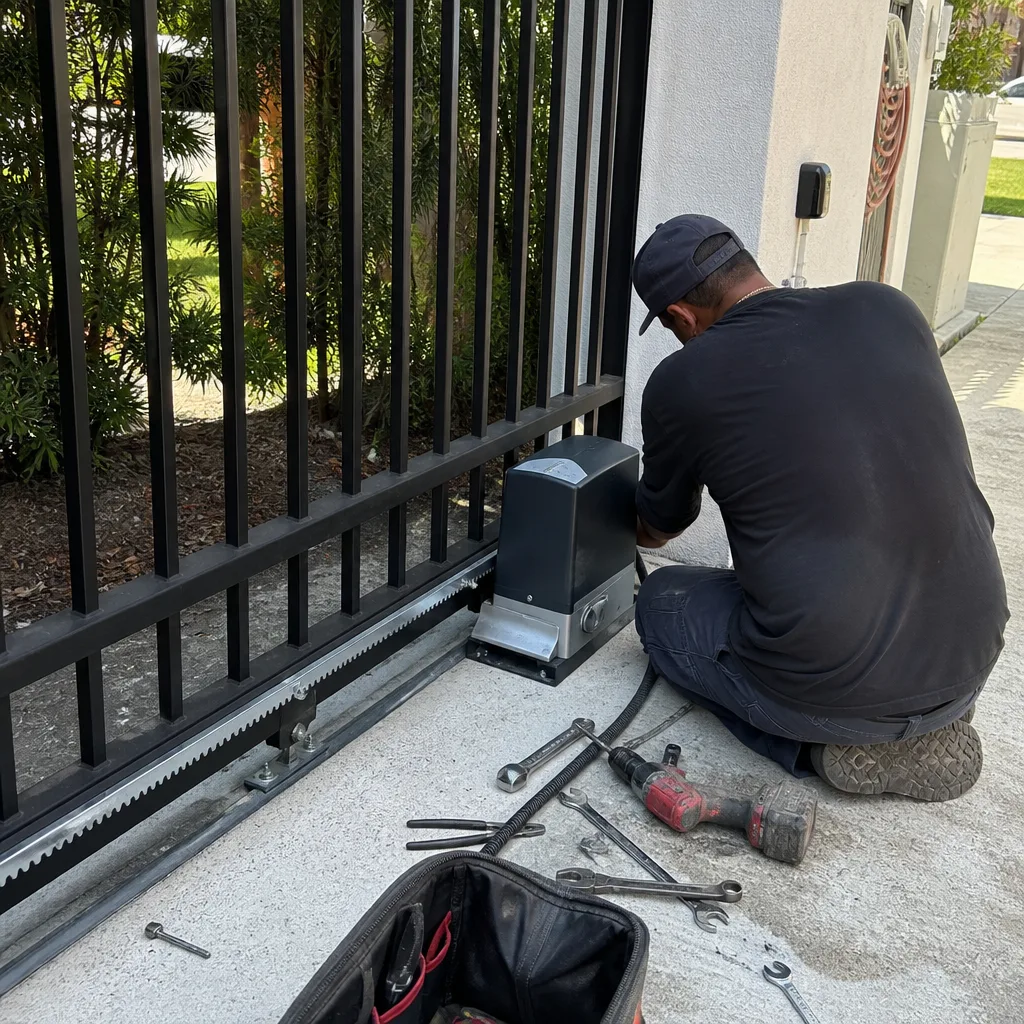 After
After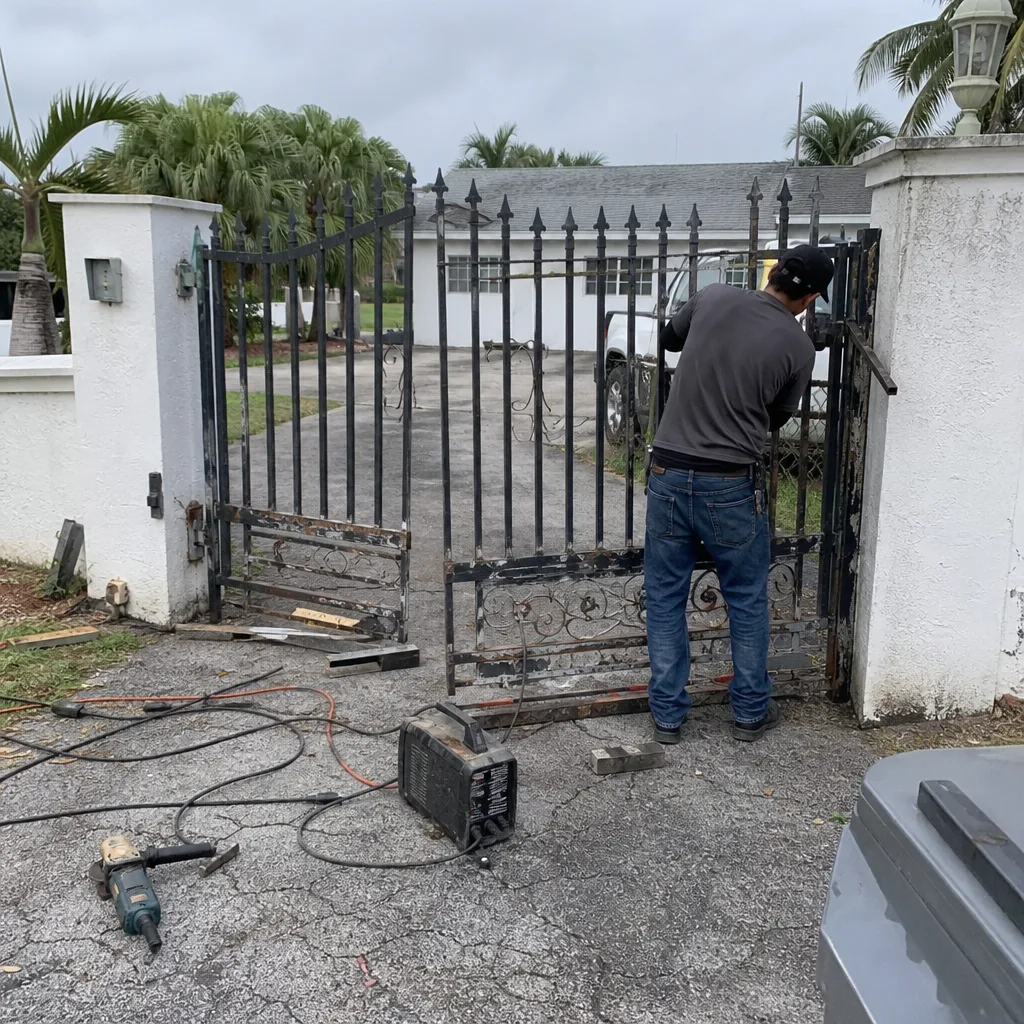 Before
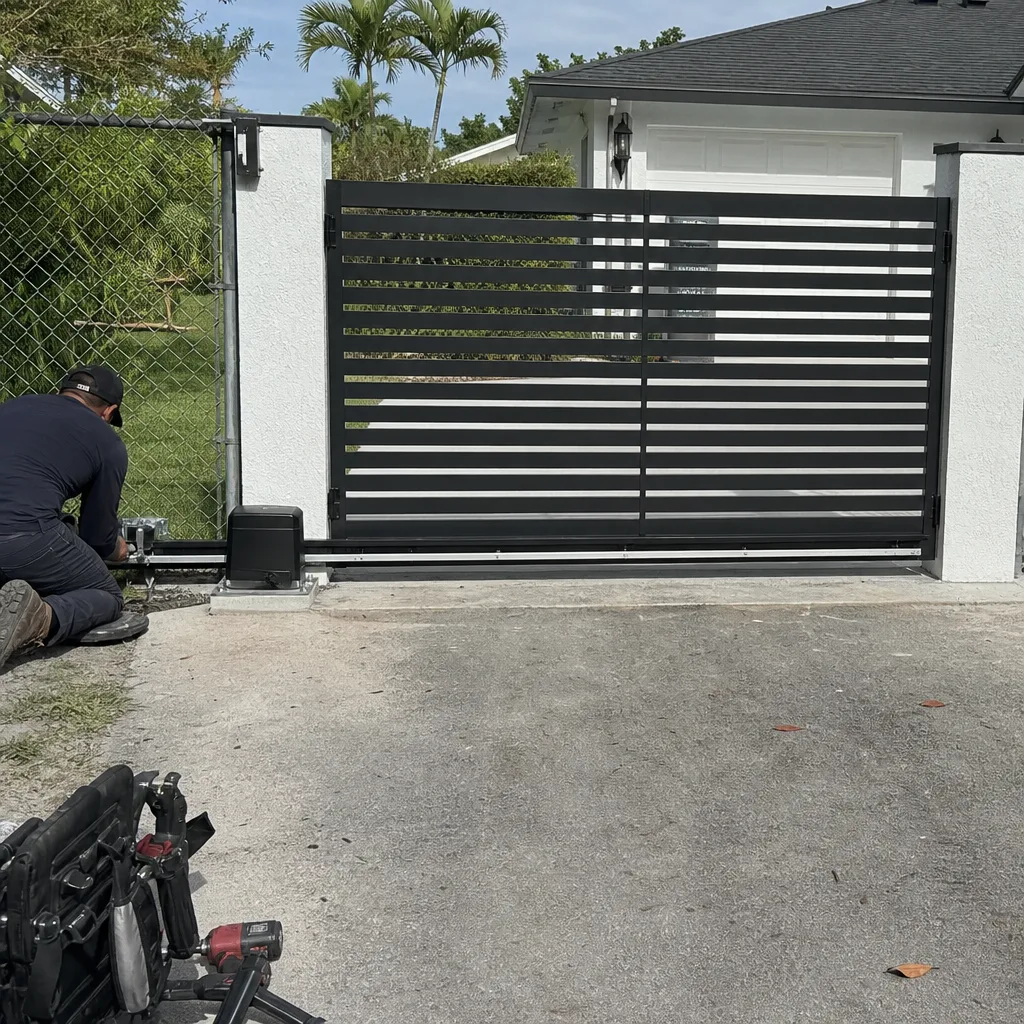 After
After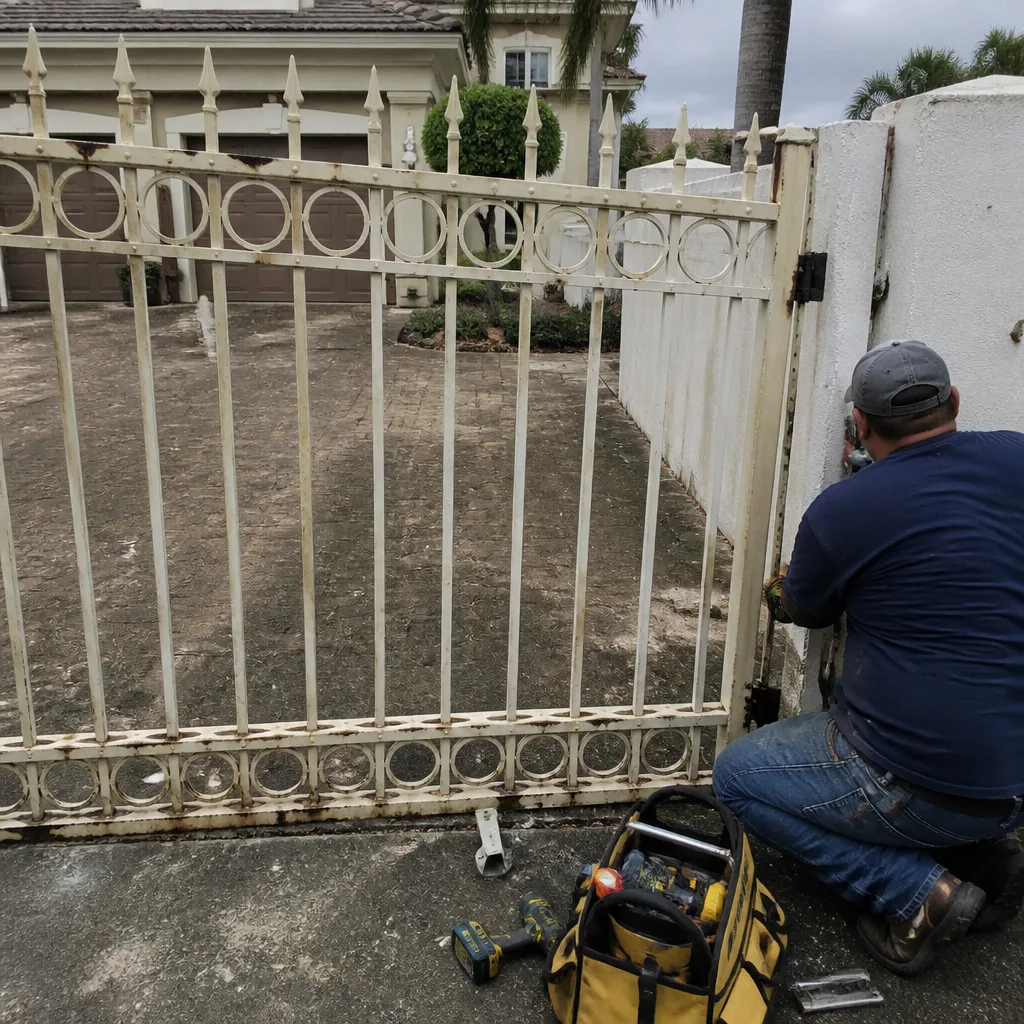 Before
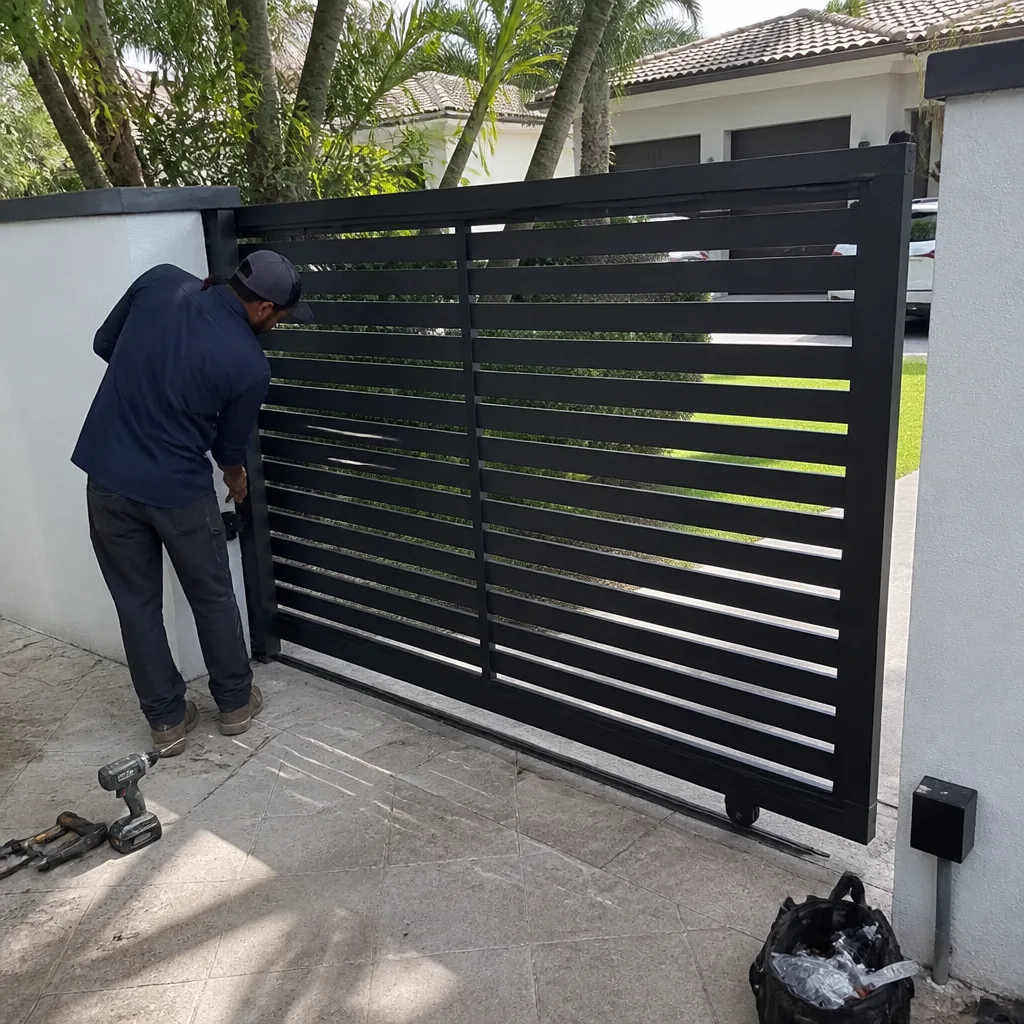 After
AfterWhen to Call a Professional
Call a professional when you hear grinding that’s new, when your gate hesitates consistently in the morning regardless of weather, when a humming sound occurs without gate movement, or when you see rust blooming at the bottom hinges or welds. These are not “keep an eye on it” situations. They’re “the clock is running” situations. Also call when your gate behaves differently after rain and the behavior persists for more than a day: that’s a drainage or electrical issue that needs a trained eye, not a guess. Calder Gate Repair Miami offers free estimates and a live person answers every call, 24/7. If you’re seeing any of the warning signs in this guide, call (850) 821-3781 for an assessment. We’ll tell you honestly whether it’s urgent or whether you have time, and the price is written before anything starts.
Frequently Asked Questions
Most gate opener repairs in Miami run between $90 and $350 before any major parts. A capacitor replacement is typically $90 to $150, a limit switch replacement $80 to $140, and a full opener replacement $650 to $1,200 installed. The biggest variable is whether the problem is caught early or allowed to cascade through the motor, board, and frame. See more guides & resources on catching issues before they spread. Call (850) 821-3781 for a free estimate with a written price before any work starts.
Morning hesitation that clears by midday is almost always a failing capacitor or a corroding limit switch affected by overnight humidity. Miami’s moisture condenses inside the opener housing, and a weak capacitor can’t deliver start voltage when damp. By noon it has dried and the gate works. The capacitor will continue to degrade, and within weeks the hesitation will become a no-start. Fixing it now costs about $90 to $150; fixing it later usually means a board replacement.
Yes. Calder Gate Repair Miami answers calls with a live person 24/7, and we dispatch technicians with a trackable arrival time. For urgent repairs, we aim for same-day service when you call before noon. Call (850) 821-3781 and tell us what the gate is doing. We’ll give you an honest assessment over the phone and get someone to you.
Yes, grinding is the most serious gate noise. It means metal is being physically removed, usually from the gearbox, chain, or track. Every cycle makes it worse, and a grinding gearbox can strip entirely within a week or two. The cost to repair it now is far less than replacing the whole opener after the gears fail completely. Call (850) 821-3781 for an assessment.
Post-rain gate problems usually fall into two categories: drainage issues and moisture intrusion. If the gate slows down but sounds normal, the soil under the gate posts or wheels has softened and the gate is binding. If the gate stops working entirely during rain but recovers when dry, water is getting into the control box or safety sensor circuit. Both issues get worse over time, and both are fixable at a lower cost than replacing the opener. Call (850) 821-3781 and describe exactly what happens after rain: it helps us narrow the cause before we arrive.
Most gate openers can be repaired rather than replaced, especially if the issue is caught early. Capacitors, limit switches, photo-eyes, chains, and even boards are all replaceable components on LiftMaster, FAAC, Mighty Mule, and other major brands. Replacement is usually only the right call when the gearbox has seized, the board has failed due to long-term neglect, or the opener is more than 15 years old and parts are difficult to source. A free estimate will tell you which path makes financial sense. Call (850) 821-3781 to schedule one.
The Bottom Line
Gates rarely fail without warning in Miami. They send signals: a two-second hesitation on humid mornings, a grinding note that wasn’t there last month, a drift after closing that you’ve started to accept as normal. The signals are readable, and acting on them early costs a fraction of what ignoring them costs later. Learn your gate’s baseline sounds and behaviors. Check the bottom hinges and welds for rust every few months. Pay attention to what your gate does after rain. When something changes, call someone who can tell you honestly whether it’s urgent. Calder Gate Repair Miami is at (850) 821-3781, and we’ll give you a straight answer, a written price, and a repair backed by the 365-Day Done Right Promise.
Written by Nico Alvarez, Owner at Calder Gate Repair Miami, serving Miami since 2009.