
Last updated October 16, 2026
 Wrought iron
 Farm & ranch
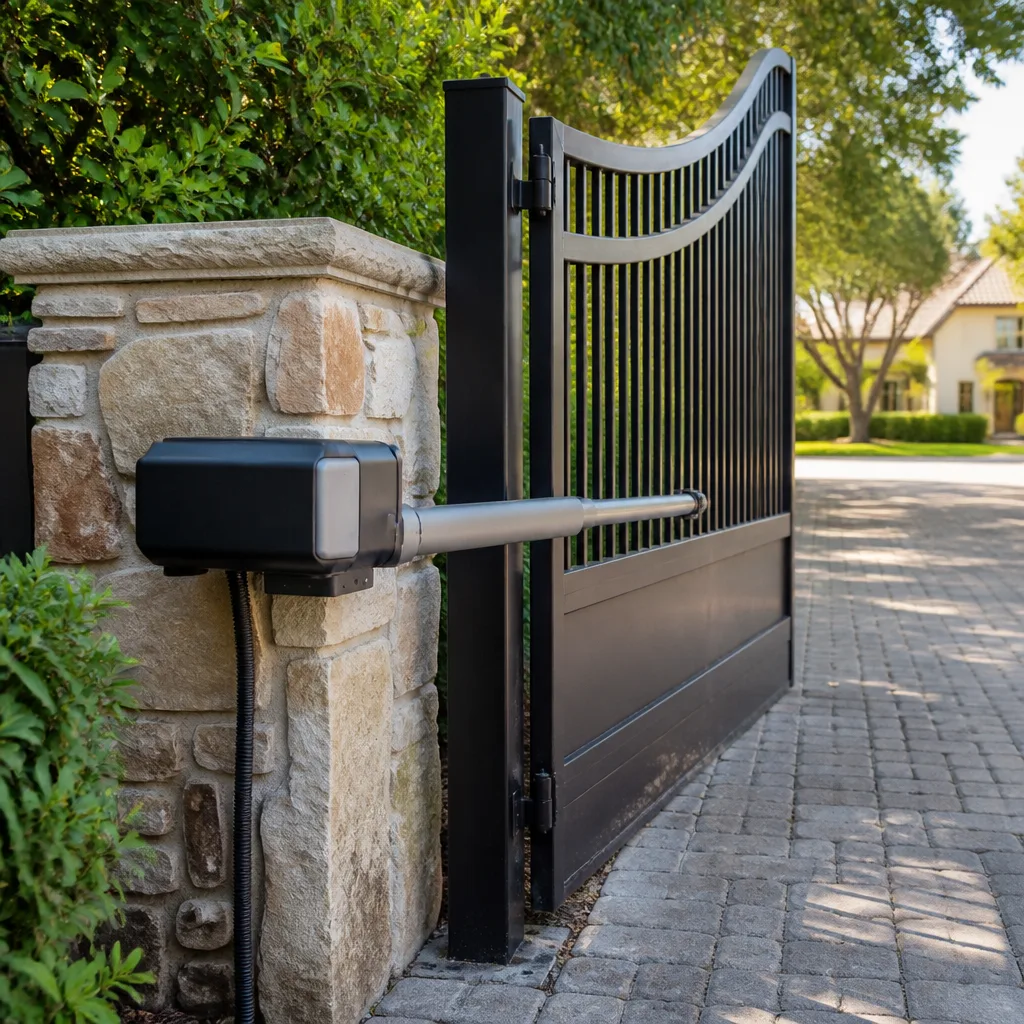 LiftMaster operators
Free on-site gate assessment - hinges, posts, and your LiftMaster or Nice gate operator checked before anything is quoted
The assessment is free and the quote is the invoice.
Get your free estimateGate Repair Maintenance Checklist for Miami Homeowners
Here’s a fact most gate maintenance guides won’t tell you: the most common avoidable gate repair call we handle in Miami comes from one skipped 10-minute task that barely appears on generic checklists. It’s not the hinges or the opener motor. It’s the photo-eye safety sensor, and specifically the condensation film that builds up on its lens during South Florida’s wet season. When that film blocks the beam, the gate thinks something is in the way and refuses to close, or worse, reverses mid-cycle. This guide is built backwards from the actual service tickets our technicians see week after week in Miami, mapped to our real seasons: dry, wet, and that tense six-week hurricane prep window. You’ll learn what to do monthly, what to do seasonally, and which products actually survive Miami’s heat, humidity, and limestone-shift soil.
Quick Answer
The core gate maintenance tasks Miami homeowners should perform are: wipe the photo-eye sensor lenses monthly during wet season (May through October), lubricate hinges and the opener chain with silicone spray every 90 days, inspect the gate posts for soil-shift lean twice a year, test the battery backup before hurricane season, and document every service or repair with dated photos. If you do these five things on schedule, you’ll prevent roughly 70% of the gate failures we see across the city.
Styles & brands we work with
Table of Contents
- Month-by-Month Maintenance Schedule for Miami’s Real Seasons
- The Photo-Eye Lens: The 10-Minute Task Most Checklists Miss
- Lubricant Selection: Why Silicone Belongs on Some Parts and Destroys Others
- Soil-Shift Inspection: Catching a Post Lean Before It Becomes a $1,200 Re-Set
- Battery and Surge Protection: Calibrating to Miami’s Lightning Frequency
- The Documentation Habit: Making Insurance and Warranty Claims Easier
- Common Mistakes to Avoid
- When to Call a Professional
- Frequently Asked Questions
Month-by-Month Maintenance Schedule for Miami’s Real Seasons
Most gate checklists you’ll find online are organized by calendar quarters, which is fine if you live somewhere with four predictable seasons. Miami doesn’t work that way. Our year splits into three operational modes: the dry season (November through April), the wet season (May through October), and the hurricane prep window (roughly mid-August through late September). Your gate responds differently to each.
Here’s the schedule we recommend to every homeowner in Miami, based on what we’ve learned from thousands of service calls:
Dry Season (November through April): Light Touch, Heavy Inspection
- Every month: Visually inspect the gate’s travel path for debris, faded safety signage, or anything that’s shifted.
- Every 60 days: Wipe down the gate itself with a damp cloth. Dry season is dust season in Miami, and dust mixes with the residual humidity to create a paste that accelerates wear on bearings and rollers.
- Every 90 days: Lubricate hinges, the opener chain, and any visible roller bearings with a silicone-based spray (more on this in the lubrication section below).
- February: Test the battery backup. February is typically one of our driest months, and it’s the easiest time to do a full-system test without rain interrupting you.
Wet Season (May through October): The Condensation War
- Every month: Clean the photo-eye lens with a dry microfiber cloth. That’s it. No chemicals, no water. The condensation film that builds during Miami’s wet season is the single biggest cause of phantom gate reversals and “the gate won’t close” calls we get.
- Every month: Check for corrosion on exposed metal parts, especially hinges and the bottom rail of the gate. Miami’s salt air and humidity work together; a gate two miles from the coast corrodes faster than one in Kendall or Westchester.
- Every 60 days: Re-lubricate, because wet-season rain washes away silicone spray faster than dry-season dust does.
- After any heavy rain: Clear standing water from the gate track (if you have a sliding gate) and check that the drain holes in the opener housing are clear.
Hurricane Prep Window (Mid-August through September): The Pre-Storm Checklist
- Test the battery backup under load: unplug the opener from power and run the gate through a full cycle. If it doesn’t move smoothly on battery power alone, replace the battery before the storm arrives.
- Inspect the gate itself for any loose bolts, weld fatigue, or cracks. A gate that’s already compromised becomes a projectile in 100 mph winds.
- Confirm that the manual release mechanism actually works. If the power goes out and the battery dies, you need to be able to open the gate by hand.
- Photograph the entire system: gate, opener, control board, posts, hinges. Date-stamp the photos. This takes five minutes and becomes invaluable if you need to file an insurance claim after the storm.
- Trim any overhanging branches near the gate’s travel path. Falling debris during a storm is the fastest way to destroy an opener arm or bend a gate panel.
This schedule covers the maintenance end. If you’re dealing with an active failure, our Gate Repair in Miami team can diagnose and fix the issue same-day in most cases.
The Photo-Eye Lens: The 10-Minute Task Most Checklists Miss
We opened this guide with the photo-eye statistic, and here’s the deeper context. In a typical May through October stretch in Miami, about one in five of our “gate won’t close” service calls turns out to be nothing more than a dirty or fogged photo-eye lens. The homeowner has tried everything, called us, paid for a diagnostic visit, and the fix takes less than ten minutes.
The photo-eye is a small infrared sensor, usually mounted near the bottom of the gate on one side and a reflector or receiver on the other side. It’s a safety device: if the beam is broken, the gate stops or reverses, because it assumes a person or car is in the path. That’s the right behavior. The problem is that Miami’s wet season creates a specific failure mode: warm, humid air hits the cooler glass lens surface, and a thin film of condensation forms. This film scatters the infrared beam just enough that the sensor reads it as an obstruction.
Here’s the step-by-step inspection routine:
- Locate the photo-eye sensor. On most residential gates in Miami, it’s a small circular or rectangular plastic housing near the base of the gate, usually on the hinge side or the catch side. Some systems have a separate reflector on the opposite post.
- Wipe the lens with a clean, dry microfiber cloth. Do not use glass cleaner, Windex, soap, or water. Glass cleaners often contain ammonia, which can fog or etch plastic lenses over time. Water leaves a residue that Miami humidity turns into a new film within days.
- If the lens is pitted or clouded permanently (which we see on older gates in coastal neighborhoods like Coconut Grove or Coral Gables), the sensor itself may need replacement. A new photo-eye runs roughly $45 – $90 for the part on most residential systems.
- Test the beam by blocking it with your hand while the gate is closing. If the gate stops or reverses, the sensor is working. If it doesn’t, there’s a wiring or alignment issue that’s worth a professional look.
This is the highest-ROI task on the entire checklist. Ten minutes, zero tools, once a month during the wet season, and you’ll avoid one of the most common service calls in our entire Miami repair log.
Lubricant Selection: Why Silicone Belongs on Some Parts and Destroys Others
Generic gate maintenance guides love the phrase “lubricate hinges.” They stop there. That’s a problem, because in Miami’s heat, the wrong lubricant can degrade into a sticky, sand-trapping paste that does more damage than no lubricant at all.
Here’s what we use, what we avoid, and why, based on years of our Gate Repair services across Miami’s residential neighborhoods:
- Hinges and pivot points: Silicone spray. It’s heat-stable up to about 400°F, which matters when your gate has been sitting in direct Broward and Dade sun for six hours. White lithium grease is a second choice, but it attracts dust, and Miami has plenty of it.
- Opener chain: Chain-specific lubricant or a light silicone spray. Chains on LiftMaster, BFT, and Linear openers run dry and fast; a heavy grease will fling off and coat the track and the opener housing.
- Roller bearings and wheels (sliding gates): Silicone spray or a light machine oil. Do not use WD-40 as a long-term lubricant; it’s a solvent first, and it strips the existing lubricant film.
- Worm gears and screw-drive threads: White lithium grease or a screw-drive-specific grease. This is the one place where a thicker grease is correct; the threads need surface-to-surface film strength.
The big rule: never use petroleum-based grease on nylon or plastic parts. Many residential openers, including Viking and Ghost Controls models, use nylon gears or bushings inside the opener. Petroleum products can soften those plastics in Miami’s heat. When a nylon gear strips, the opener usually needs a full tear-down or replacement, a repair that runs $200 – $400 in parts and labor.
If you’re not sure which lubricant belongs on your specific system, our Gate Opener Repair in Miami technicians can point you to the right product for your exact brand, and we stock the correct lubricants for every opener we service.
Soil-Shift Inspection: Catching a Post Lean Before It Becomes a $1,200 Re-Set
Miami sits on limestone, and limestone soil does something predictable: it shifts. The wet season saturates the topsoil, the dry season bakes it, and the whole cycle repeats year after year. What this means for your gate is that the posts holding the hinge side and the catch side can slowly drift out of plumb, even on a property that’s been stable for a decade.
The repair for a badly shifted post is a re-set: we dig out the old footing, re-bed the post in fresh concrete, and re-hang the gate. It’s a real job, and in Miami the labor alone typically runs $700 – $1,200 depending on access, post size, and whether the old footing needs a full demo. Catching the problem early costs nothing.
Here’s how to spot a developing post lean without any specialized tools:
- Stand at the latch end of the gate and sight down the top rail. It should be a straight, continuous line. If it dips or bulges at the hinge side, that post is moving outward.
- Check the gap between the gate and the catch post at the top and bottom. If the top gap is wider than the bottom gap, the hinge post is leaning away from the load. If the bottom gap is wider, the post is leaning toward the gate.
- Look at the concrete base of each post. Fresh hairline cracks, especially cracks that grow between inspections, are the first visible sign of footing stress.
- Watch the gate as it opens and closes. It should stay parallel to the ground the whole time. If it visibly lifts or drops at the latch end, the hinge post has moved.
Do this twice a year, once in June after the first heavy rains and once in January after the dry season has hardened things up. If you catch movement early, the fix is often a simple shim and re-alignment, not a full re-set. If you’re seeing cracks or a visible lean, get a Electric Gate Repair in Miami professional out to assess the foundation before the problem compounds.
Battery and Surge Protection: Calibrating to Miami’s Lightning Frequency
Miami sees more lightning strikes per square mile than any other major city in the United States. That’s not a fun fact, it’s a maintenance variable. Your gate opener’s control board is a sensitive piece of electronics, and a nearby strike can fry it even if the power doesn’t go out. The surge doesn’t have to hit your house directly; a strike on the utility lines a half-mile away can send a spike straight into your opener.
Here’s the Miami-specific maintenance routine:
- Check the surge protector every 90 days. Most proper gate opener installations include a surge protector at the outlet or in the opener’s power supply. Surge protectors wear out after they absorb a certain number of spikes. If yours has an indicator light and it’s off, replace it. A quality surge protector for a gate opener runs $35 – $80 and takes ten minutes to swap.
- Test the battery backup every 60 days during the wet season. The battery is supposed to keep your gate operational during a power outage, and in Miami, power outages happen in clusters during storm season. The test is simple: unplug the opener from its outlet and run the gate through a full open-close cycle on battery power only. If it moves sluggishly or doesn’t move at all, the battery is done. Most gate opener batteries last 2 – 3 years in Miami’s heat, not the 5 years you’ll see on the spec sheet.
- If you have a whole-house surge protector, verify that your gate’s circuit is covered. Some older Miami homes have the gate opener on a separate sub-panel or an exterior outlet that isn’t protected by the main panel surge unit.
Battery replacement on a residential opener typically runs $60 – $120 for the part, and most brands, including BFT, Linear, and Ghost Controls, use a standard 12V sealed lead-acid or lithium battery that’s easy to source. The labor to swap it is usually minimal, and if you’re not comfortable working with electrical components, it’s a fast visit for a Gate Opener Repair in Miami technician.
The Documentation Habit: Making Insurance and Warranty Claims Easier
We tell every homeowner in Miami the same thing: a dated photograph is worth more than a written description when something goes wrong. It’s not glamorous, it’s not in most checklists, and it’s the single best habit you can build for the day you actually need it.
Here’s the documentation system we recommend, tailored to Miami’s specific realities:
- Photograph the entire gate system three times a year: once at the start of the dry season, once at the start of the wet season, and once during the hurricane prep window. Each session takes five minutes. Shoot the gate from both sides, the opener housing, the control board, the hinges, the posts, and the photo-eye.
- Name the files with the date. “Gate_June_2026_hinges.jpg” is good. “IMG_4471.jpg” is useless when you’re trying to prove you had no pre-existing damage before the storm.
- Photograph any repair or service work immediately after it’s completed. If a technician replaces a board, installs a new battery, or re-aligns the gate, the after-repair photo is your baseline for everything that follows.
- Keep a simple text file or note on your phone with gate repair dates and what was done. When a warranty claim comes up, the homeowner who can say “the opener was replaced on March 12, 2024, and here’s the invoice” gets a much faster resolution than the one who says “I think it was done sometime in 2023.”
This habit pays off in two specific Miami scenarios. First, hurricane damage claims: if a storm damages your gate and you have dated pre-storm photos, your insurance claim becomes materially simpler. Second, warranty work: if a part fails inside the manufacturer’s warranty window, the documentation proves the install date and the condition before the failure. Most manufacturers honor warranty claims, but they move faster when the homeowner can document the timeline.
Every Calder Gate Repair Miami home inspection includes photos taken before and after the work, so you’ll always have a clear baseline even if you forget to take your own.
Common Mistakes to Avoid
- Using WD-40 as a lubricant for hinges and chains. WD-40 is primarily a solvent. It cleans, then it evaporates, and it leaves behind almost no lasting lubrication. In Miami’s environment, a hinge that’s been “lubricated” with WD-40 will be dry and squeaking again within two weeks, and now the old lubricant film is gone too.
- Ignoring a slow gate. A gate that’s opening or closing slower than it used to is usually telling you something: the capacitor is fading, the battery is weak, or the chain tension is off. Waiting until it fails completely turns a simple repair into a full-opener replacement.
- Power-washing the gate and the opener housing. Miami homeowners love pressure washing, but a direct jet of water into the opener housing or onto the photo-eye will cause more corrosion and electrical problems than it solves. Use a garden hose and a soft brush instead.
- Lubricating the photo-eye lens. Some homeowner finds a foggy lens, assumes it needs oil, and sprays it. That’s a worse problem than the condensation, because oil attracts dust, and now the lens is permanently clouded. If wiping with a dry cloth doesn’t clear it, the lens needs replacement, not lubrication.
- Skipping the battery check because “the power never goes out where I live.” In Miami, the question isn’t if the power goes out, it’s when. Every neighborhood in the city has outages during the wet season, and if your gate won’t open on battery when the power is down, you’re trapped in or locked out until the utility restores service.
- Attempting DIY spring or cable replacement. Gate springs and cables are under hundreds of pounds of tension. A gate spring that releases its tension unexpectedly can cause serious injury. This is a professional repair, full stop.
When to Call a Professional
Call a professional when the gate stops moving entirely, when it reverses mid-cycle repeatedly after you’ve cleaned the photo-eye, when the opener makes a grinding sound that doesn’t improve after lubrication, when a post shows visible lean or footing cracks, or when any spring or cable needs replacement. Those are the scenarios where a trained eye and the right tools prevent a small repair from becoming a full replacement (see Gate Repair Warning Signs: A Miami Homeowner’s Reference Guide for earlier indicators).
Calder Gate Repair Miami offers free estimates across Miami and the surrounding area. Call (850) 821-3781 and we’ll send a background-checked, uniformed technician with a live, trackable arrival time, a written price before any work starts, and a written guarantee on every repair.
Frequently Asked Questions
DIY maintenance costs are minimal: a can of silicone spray runs $8 – $15, a microfiber cloth costs a few dollars, and a replacement battery for the opener runs $60 – $120. Professional maintenance visits in Miami typically run $85 – $150 for a full inspection and tune-up, depending on the gate type and the opener brand.
Most gate repair calls in Miami can be handled same-day or next-day, especially during the dry season. During the wet season, demand spikes because rain and humidity cause more failures, so calling earlier in the week gives you the best chance at a same-day slot. For urgent repairs, call (850) 821-3781 and our team will give you a real arrival window.
A full maintenance visit typically includes cleaning and testing the photo-eye, lubricating all moving parts with brand-appropriate products, checking chain tension, testing the battery backup, inspecting the posts for lean, checking the surge protector, and testing the opener’s open and close force settings. We also photograph everything so you have a dated baseline for warranty and insurance purposes.
Yes. Our technicians are factory-familiar with Viking and Ghost Controls, along with LiftMaster, FAAC, BFT, Linear, DoorKing, Elite, and Mighty Mule. If you’re having trouble with a specific brand, call (850) 821-3781 and we’ll send someone who’s worked on that exact model before.
You can absolutely do the monthly and seasonal tasks in this checklist yourself. Most Miami homeowners are capable of cleaning the photo-eye, lubricating hinges, and doing the visual inspections. The value of a professional maintenance visit is that it catches the things you can’t see from the outside: capacitor wear, board corrosion, wire insulation breakdown, and chain stretch.
Every repair we perform carries the 365-Day Done Right Promise: if the repair fails within 365 days, we return at no charge. That’s in writing on every job, along with the written price we quoted before any work began.
The Bottom Line
Your gate in Miami lives in an environment that punishes neglect faster than almost anywhere else in the country: heat that degrades lubricant, humidity that fogs sensors and corrodes metal, lightning that fries boards, and soil that shifts posts out of alignment on a seasonal schedule. The maintenance routine that actually works here is specific: wipe the photo-eye monthly during the wet season, use silicone spray on hinges and chain every 90 days, check for post lean twice a year, test the battery before hurricane season, and document everything with dated photos. Do that, and you’ll avoid the majority of the repair calls we see across Miami. For additional help, explore more guides & resources. Skip it, and you’ll be calling us for a job that ten minutes of monthly attention would have prevented.
Need help with a gate that’s already acting up? Calder Gate Repair Miami is the dedicated gate repair specialist inside the Relay Home Co. family, serving Miami since 2009. We answer every call with a live person, 24/7. Call (850) 821-3781 for a free estimate, and we’ll put the price in writing before a single bolt is turned.
Written by Nico Alvarez, Owner at Calder Gate Repair Miami, serving Miami since 2009.
See the difference
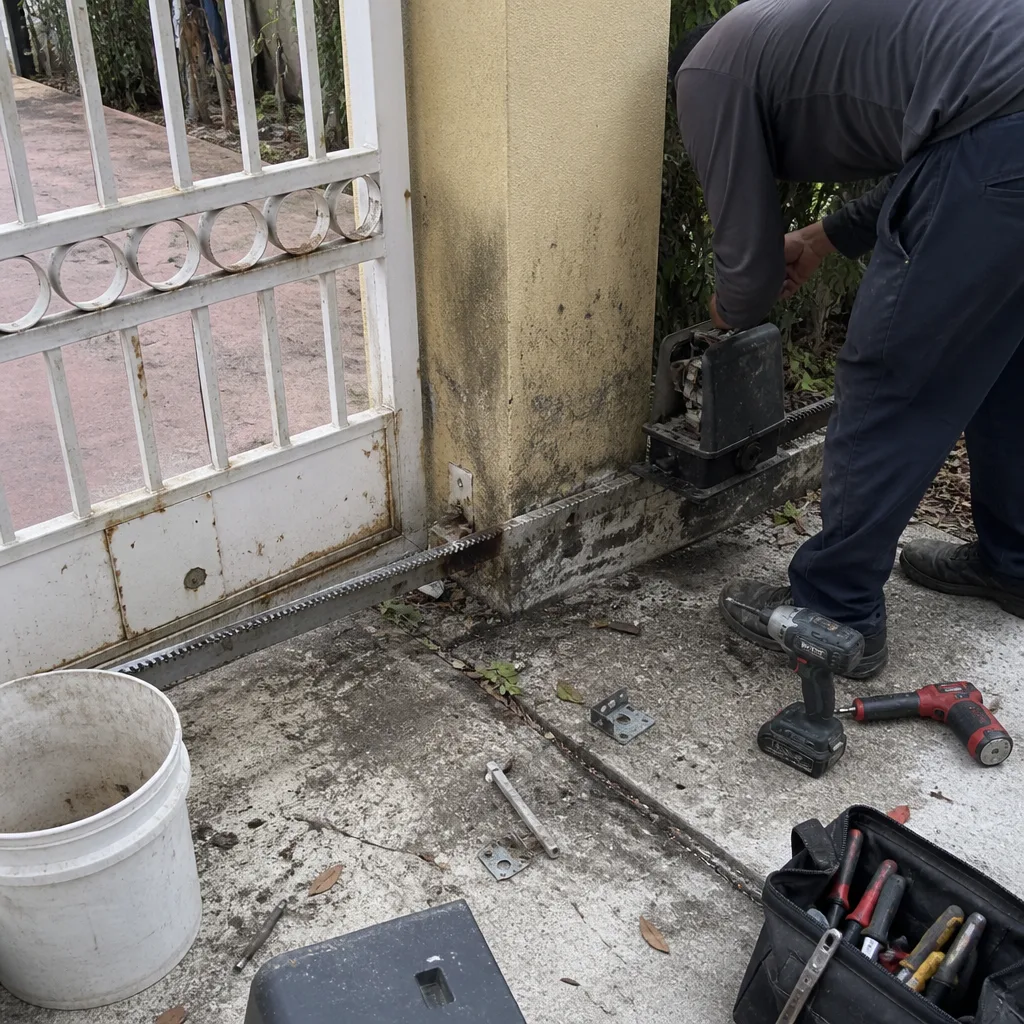 Before
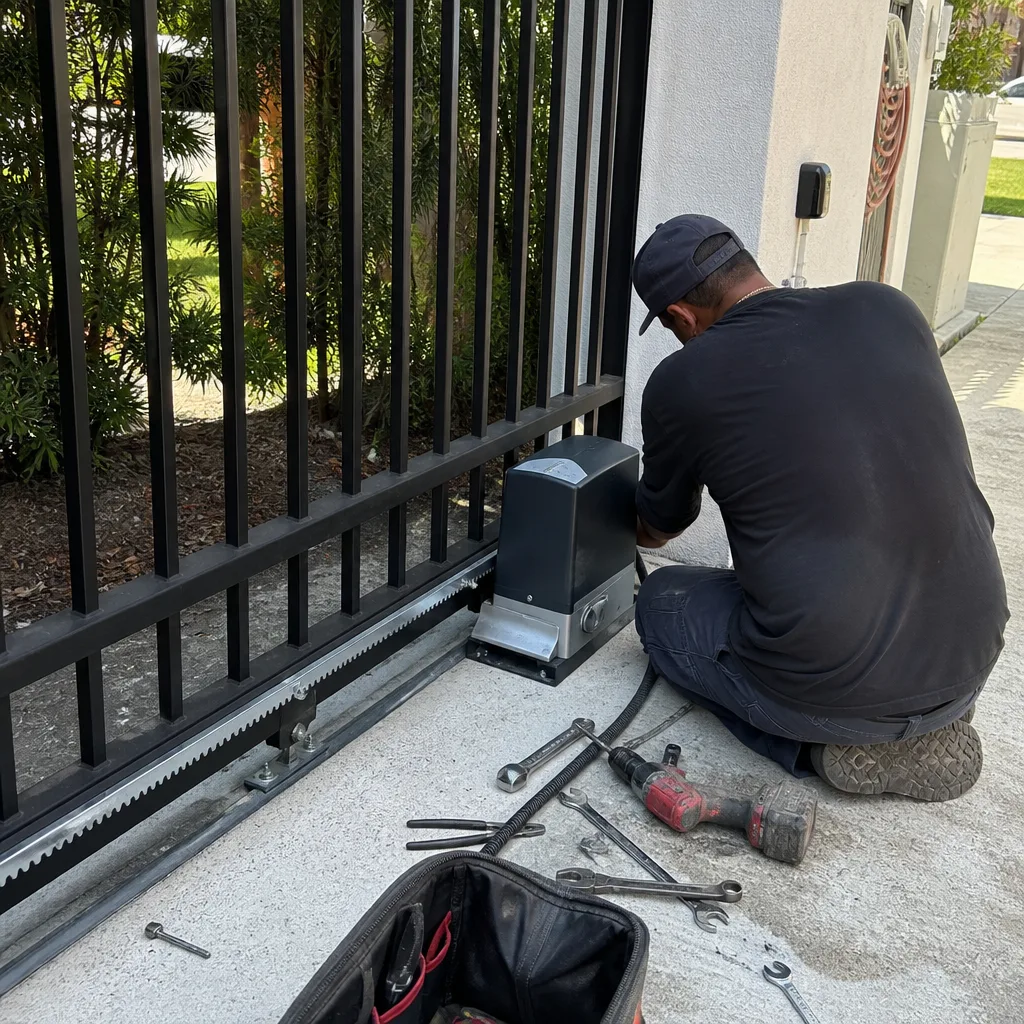 After
After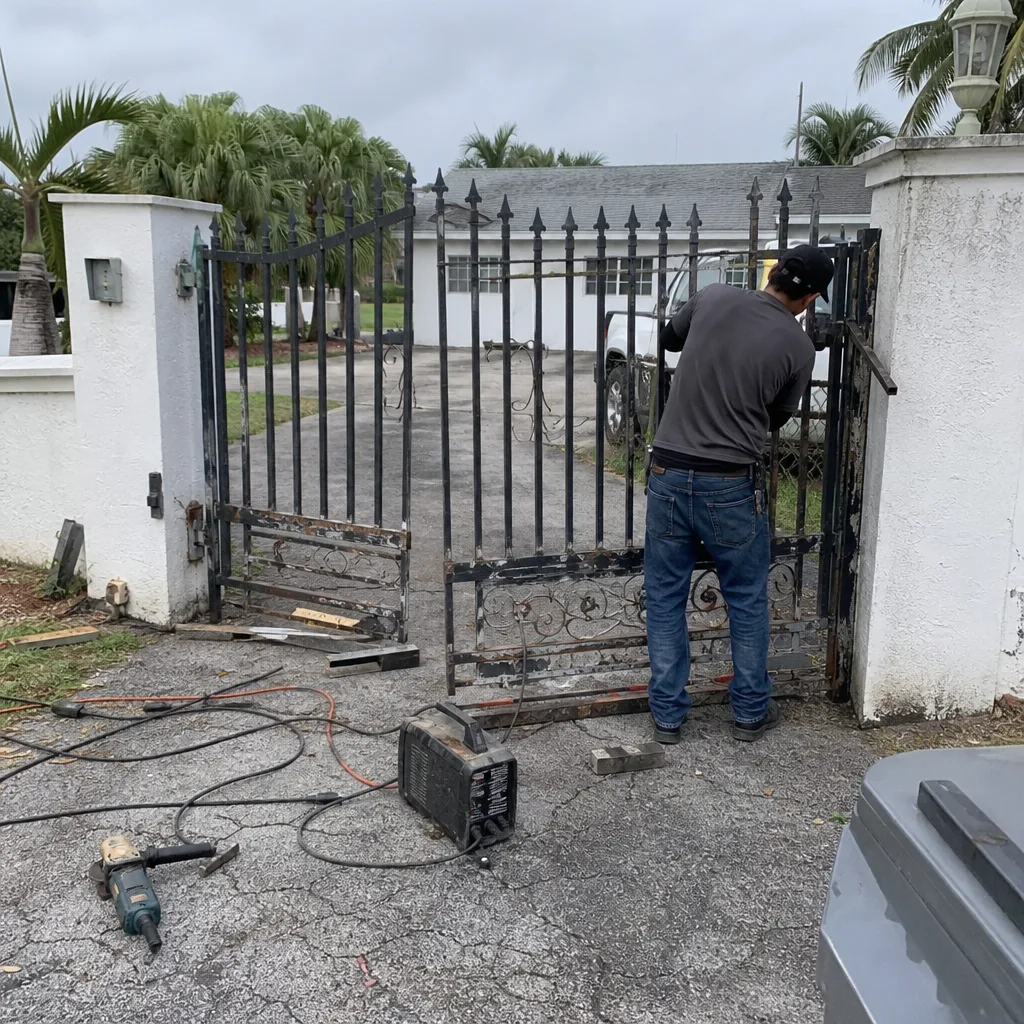 Before
 After
After Before
 After
After